


Views: 0 Author: Site Editor Publish Time: 2026-02-27 Origin: Site


When buyers compare submersible pumps, they often start with the basics: flow rate, head, power, and material. That’s necessary—but it’s not enough. The real difference between a pump that runs smoothly for years and a pump that turns into a maintenance problem usually comes down to what happens inside the motor and seal area under real site conditions: temperature rise, lubrication stability, sand or solids exposure, start-stop frequency, and long-term sealing performance.
That’s exactly where an Oil Cooling Submersible Screw Centrifugal Pump becomes attractive. It combines two practical advantages in one solution: stable hydraulic performance (from the screw/centrifugal working principle) and reliable motor temperature management (from oil cooling). In demanding applications—such as construction dewatering, industrial wastewater transfer, mining drainage, municipal pumping stations, and sump/shaft pumping—those two advantages can translate into fewer shutdowns and more predictable operation.
At Qingdao Gongli Technology Co., Ltd., we see customers choose oil cooling submersible screw centrifugal pumps when they want more than “a pump that meets the curve.” They want a pump that keeps running in tough environments, handles variable conditions with less risk, and stays efficient without overheating. In this article, we’ll explain what this pump type is, how oil cooling works, what “screw centrifugal” means in real performance, and the most common reasons buyers choose it over conventional submersible centrifugal designs.
Let’s break the name into three parts:
Submersible pump: the pump and motor operate submerged in the fluid or in a wet environment.
Screw centrifugal hydraulic design: an impeller design that blends screw-like conveying behavior with centrifugal energy transfer.
Oil cooling: the motor uses oil (inside the sealed motor cavity) to help remove heat and stabilize internal temperature.
This combination is designed for applications where the pump needs to run reliably even when:
solids are present
flow conditions change
the pump runs for long periods
the site temperature and duty cycle raise motor heat
A submersible motor is compact and sealed. Heat management becomes a key factor in service life. Oil cooling helps in several ways:
Oil can transfer heat efficiently from hot motor components to the outer motor shell, where it can dissipate into the surrounding fluid. Stable temperature helps protect:
insulation system
bearings
seals
cable entry components
Oil also acts as a lubricating medium inside the sealed system. When lubrication and cooling are both stable, mechanical wear tends to reduce.
Sites with frequent start-stop cycles, long-running duty, or higher ambient heat can push motors toward thermal stress. Oil cooling provides an extra margin that helps maintain reliable operation.
Practical takeaway: if overheating or thermal alarms have caused downtime in your site history, oil cooling is a feature worth prioritizing.
A traditional centrifugal pump can be efficient, but it may struggle when fluid quality changes, especially with mixed solids or fibrous content. Screw centrifugal hydraulics are often chosen because they can offer:
The screw-like inlet and impeller geometry can reduce clogging risk and help convey solids more smoothly than conventional closed impellers in some applications.
Screw-related conveying behavior can make flow feel steadier in variable conditions, which can be valuable for process stability.
Real pumping systems rarely stay at a perfect design point. Screw centrifugal designs can be more tolerant when flow/head conditions vary, reducing performance instability.
Here are the most common reasons we hear from customers:
Oil cooling supports better thermal management, which is especially valuable when pumps run for long hours in pits, sumps, or stations.
Screw centrifugal hydraulics are often selected for wastewater, sludge-like mixtures, and drainage with debris.
A cooler, more stable motor environment helps reduce long-term stress on critical components.
Construction sites, mining drainage, and industrial wastewater systems are unpredictable. Buyers choose this pump type to maintain consistency when conditions aren’t ideal.
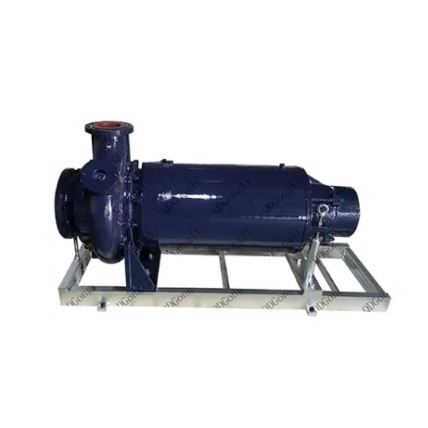
When buyers compare these two options, we recommend thinking in terms of risk control rather than “which one is better.” A standard submersible centrifugal pump can be an excellent choice for clean water and stable operating conditions. But when the job site is unpredictable—solids appear, duty cycles change, temperature rises, or the pump runs long hours—the oil cooling submersible screw centrifugal pump is often selected because it provides a wider safety margin.
Feature | Oil Cooling Submersible Screw Centrifugal Pump | Standard Submersible Centrifugal Pump |
Cooling approach | oil-assisted internal cooling | typically water jacket / external dissipation |
Solids handling | generally stronger tolerance | depends heavily on impeller type |
Clogging resistance | often better in debris/solids | can be sensitive to fibrous solids |
Stability in variable duty | stronger thermal margin | can be limited by temperature rise |
Best use cases | harsh dewatering, wastewater, mining | clean water, stable conditions |
What this table really tells you is: if your system is “clean and predictable,” a standard pump may be the most economical solution. If your system is “dirty, variable, or continuous,” the screw centrifugal + oil cooling combination is often chosen because it reduces downtime risk. Of course, this is a general comparison—final selection should always match the exact fluid, solids, and duty conditions.
In the field, oil cooling submersible screw centrifugal pumps are commonly chosen for applications where operating conditions are not ideal and reliability is a priority:
Construction dewatering (pits, foundation drainage): water quality changes daily, and debris is common.
Industrial wastewater transfer: mixed solids and variable flow demands call for better clogging tolerance.
Mining drainage and shaft pumping: long run times, harsh environments, and difficult access make reliability essential.
Municipal pumping stations with solids: sludge-like mixtures and fibrous content can challenge conventional impellers.
Stormwater and sump pumping: sudden inflows and dirty water require stable performance.
Process water with debris: when process conditions vary, tolerance and stability reduce operational interruptions.
A useful decision rule is: if you expect solids + long running hours + limited maintenance access, buyers often lean toward this pump type to avoid repeated site interventions.
To select the right model, it helps to confirm parameters in a structured way. Many “wrong pump” problems come from missing one practical detail—like pipeline losses, solids size, or installation depth.
Key parameters to confirm:
Flow rate and head (your real duty point, not only maximum values)
Solid size and solids concentration (including whether solids are fibrous or abrasive)
Fluid temperature and pH range (affects materials and seal choices)
Required run time (continuous vs intermittent, and start-stop frequency)
Installation depth and power supply (cable length, voltage, frequency)
Discharge connection and pipeline losses (elbows, long lines, lift height, valves)
Control method (float switch, level sensor, VFD, panel integration)
If you can provide these inputs, selection becomes straightforward—and a pump matched to real site conditions will almost always outperform a pump chosen by headline specs alone.
An Oil Cooling Submersible Screw Centrifugal Pump is often chosen when reliability matters as much as performance. Oil cooling helps stabilize motor temperature and reduce thermal stress under demanding duty cycles, while screw centrifugal hydraulics support better tolerance for solids and variable site conditions. For applications like dewatering, mining drainage, and industrial wastewater transfer, this combination can reduce clogging risk, improve consistency, and help keep operations running with fewer interruptions.
At Qingdao Gongli Technology Co., Ltd., we support customers selecting submersible pumps that match real-world fluids, duty cycles, and installation constraints. If you’re evaluating an oil cooling submersible screw centrifugal pump for your project, you’re welcome to learn more and contact Qingdao Gongli Technology Co., Ltd. for product information and selection support.
It is commonly used for demanding pumping jobs like construction dewatering, wastewater transfer, mining drainage, and sump pumping where solids and harsh duty cycles are common.
Oil cooling helps transfer heat from motor components more efficiently and supports stable internal temperature, improving reliability during long run times.
In many applications, screw centrifugal hydraulics are chosen because they reduce clogging risk and convey solids more smoothly compared with some standard centrifugal designs.
Confirm your duty point (flow/head), solids size and content, fluid properties, run time requirements, installation depth, and control method to ensure the pump matches your site.


